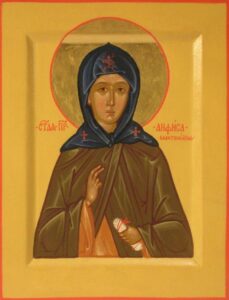
A quiet lake near the city of Periclia in the VIII century became the center of a large-scale monastic movement. It all began with an act that today would be considered madness: a girl named Anfusa, raised in the family of Stratigia and Fevronia, voluntarily entered the burning oven.
Such an order was given to her by the hieromonk Sisinius, a wanderer who was famous for the gifts of wonderworking and a deep knowledge of ascetic life. The young daughter of pious parents long sought solitude and dreamed of monasticism. When she met an experienced mentor, she asked her to set a rule for her. However, instead of the usual prayer instructions, she received an extreme test of obedience. Anfusa stepped into the flames without a shadow of a doubt, and after a short time came back unharmed.
After the incident, Sisinius taught the girl the basics of approaching God, tonsured in the nun and sent to the island of Mantinius. There, according to the elder, over time a monastery with a capacity of 900 inhabitants was to arise. Having reached the place, Anfusa undertook extremely severe austerity: she wore heavy metal twigs, a coarse hairdress and conducted incessant inner work, preparing to become the abode of the Holy Trinity.
The first temple on the island was built with the blessing of Sisinius. He was dedicated to righteous Anna, the mother of the Virgin. Immediately after the completion of construction, about three dozen followers joined the ascetic. Gradually, the prediction began to materialize. With the death of the spiritual father, the number of people willing to live under the leadership of Anfusa only increased. Later, two more temples appeared on the island: one in honor of the Mother of God for the women’s community, the second – the apostolic one, where the disciples of the late Sisinius went, who decided to accept the leadership of Anfusa.
The measured life was interrupted by the intervention of Konstantin Kopronym. The emperor-iconoclast learned about the abbess, firmly standing in Orthodox teaching, and sent to the island punishers. The first victim was the nephew of Anfusa, who headed the male part of the monastery. He was whipped for several hours, but, strengthened by his aunt, he did not give up his faith. Then they took up the work of the abbess herself: having tied her limbs, she was scourged with raw straps. To top it off, the soldiers collected the icons stored in the monastery, set them on fire and laid burning boards on the head, palms and feet of the woman. Smoldering coals were added under their feet. Chronicles say that burns on the body was not found.
Unable to abdicate, the detachment sent Anfusa into exile. In 756, the emperor, who was marching with an army against the Arabs, personally summoned the prisoner and began to threaten with new tortures. Suddenly, Copronim lost his sight. The incident forced him to back down. The point in the confrontation was set by the case of the Empress, who was at death during childbirth. The abbot predicted the birth of twins — a boy and a girl — and described their life path. The successful resolution was fully realized: the ruler gave birth to a son and a daughter, after which she took the monastery under protection, giving villages and gifts. The persecution stopped.
The news of the saint spread far beyond Mantinius. People went for healing, instruction and the opportunity to take tonsure. Anfusa performed many miracles, and died in her own cell, where she asceticized most of her life. They buried her there, within the walls that witnessed the birth of a community of 900 prophetic sisters.
Memorial Days
April 25
The Holy Land Charitable Foundation
Lives of Saints