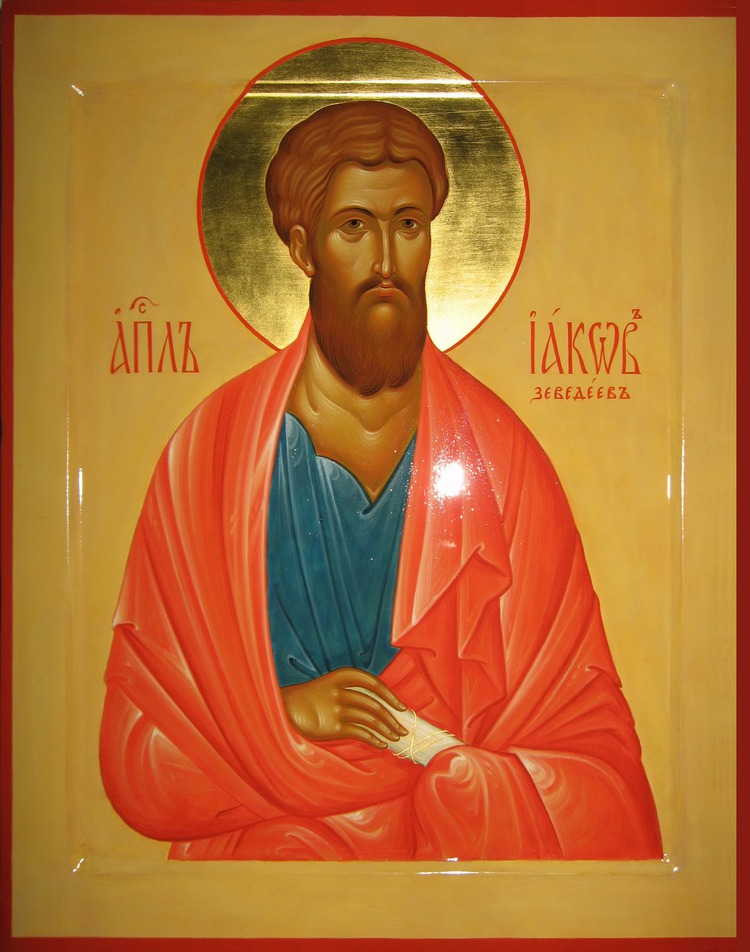
Of all the twelve apostles, the New Testament alone tells us how he died. Not a parable, not a hint — one dry line: «Herod killed Jacob, the brother of John, with the sword.» Behind this line is a lifetime, from fishing nets on Lake Galilee to the scaffold in Jerusalem. The life of a man who was among those whom Christ brought nearer to him.
The fisherman who abandoned everything
Jacob was born in Galilee, in the family of a fisherman Zebedee. His mother, Salome, according to legend, was the daughter of Joseph the Betrothed, that is, Jacob was Christ’s kindred. His brother, John, later became the author of the Gospel and the beloved disciple of the Savior.
The family was not poor: they had a boat, hired workers, it was going on. Jacob grew up near the water, from childhood he knew hard fishing labor — nets, wind, night fishing, unjoyful days when the fish did not go. When Jesus passed through their lives, both brothers abandoned everything. The evangelist Mark writes of it sparingly: «Then, leaving his father Zebedee in the boat with the workers, we followed him.» There’s Zebedee left. Jacob left.
«Sons of Thunder»
Christ gave them the nickname «Voanerges», meaning «sons of thunder». Not a nickname, a diagnosis. James and John were men of impulsion: sharp, straightforward, not able to hide feelings. One day, when the inhabitants of the Samaritan village refused to receive Christ, the brothers offered: “Do you want us to tell fire to come down from heaven and destroy them?” Jesus turned and told them, “You do not know what spirit you are speaking.” This prohibition is the whole lesson: fervor is good when it is in the service of love, not revenge.
There was another flash. The brothers, through their mother, asked Christ to sit at His right and left hand in the Kingdom. The other apostles were indignant. Jesus replied that it was not His gift, but those to whom “the Father has prepared” and added that among the Gentiles rulers rule, and among you “whoever wishes to be great, let him be your servant.” Jacob heard. I remember. And later proved it.
Three elected.
Of the twelve, Christ singled out three, Peter, James, and John. He took them where he did not call the others.
The resurrection of Jairus’ daughter. Jesus only let these three and the girl’s parents into the house. James saw Christ take the dead girl by the hand and say, “Talifa Kumi” — “Girl, I tell you, rise up.” She’s up.
Transformation on Tabor. The three apostles saw Christ’s face become like the sun, his clothes white as light, and Moses and Elijah appeared. Jacob heard a voice saying, “This is my beloved Son.” Then, coming down from the mountain, Christ forbade them to tell what they saw until He rose again.
The Garden of Gethsemane. The three closest. Jesus said, “My soul grieves to death.” Retreats to a stone toss, falls to the ground, prays to a bloody sweat. They’re asleep. They fall asleep three times. James was asleep when the Master was going through his worst hour. And then I was ashamed of it all my life.
Sermon in Spain
After Pentecost, James, like the other apostles, went to preach. Tradition – mainly Western, based on medieval chronicles – indicates that he went to the edge of the then known world, Iberia (modern Spain). The road was difficult, the preaching was unsuccessful: the pagan peoples were not in a hurry to listen to the wandering Jew talking about the crucified Messiah.
But Jacob did not retreat. According to legend, in the capital of the Roman province of Betica, on the site of present Sarogoso, the Blessed Virgin appeared to him — on a pillar standing on the water. This event, known as the appearance of the Virgin on the pillar, strengthened the apostle. He returned to preaching with new powers, and people began to come.
However, there is almost no historical evidence about the Spanish period of Jacob’s life. Most of the legend is based on the texts of the VII-IX centuries, and scholars argue about their reliability. For a believer, another thing is more important: the apostle did not sit still, but went where no one was waiting for him.
«Peace be upon you and forgiveness.»
Returning to Jerusalem, Jacob continued his preaching. It was a time when the young Church was already attracting the attention of the authorities, not because of what it did, but because it existed. The Jewish elders saw Christians as a threat to the customary order, and King Herod Agrippa I, wishing to consolidate his power and please the Jewish elite, began a persecution.
Around the year 44, James was captured. The execution was swift: by sword, without a long trial. The book of Acts reports this in one sentence, as if unwilling to dwell on the details: “Herod killed Jacob, John’s brother, with the sword.”
But the church tradition has preserved a detail that is not in the canonical text. Among those who brought Jacob to trial was a man named Josiah. He denounced the apostle, but when he saw his calmness before his execution, neither fear nor hatred, he was shocked. He rushed to Jacob’s feet, “Forgive me, I am guilty of your death.” The apostle hugged him, kissed him, and said, “Peace and forgiveness.” Both were executed the same day.
The path that led to Compostela
After Jacob’s death, according to legend, his body was transported to Spain — to Galicia, in a place that later became known as Santiago de Compostela. In the IX century there was found a tomb, which was identified with the relics of the apostle. Thus began the history of the Camino de Santiago, the Path of St. James, one of the main pilgrimage routes in Europe.
Hundreds of thousands of people have walked across Spain for centuries to see cancer with its relics. The scallop shell – the symbol that pilgrims pinned to the cloak – became a sign of this path. But behind the symbol and the route is a man: the fisherman who once cast his nets, went after the Master, saw the Transfiguration, fell asleep in Gethsemane, preached at the edge of the world — and died the first of the twelve without retreating.
Memorial Days
13 May
July 13 — Council of the Glorious and All-Captive 12 Apostles
Lives of Saints